
The Costumes and the Look!...
The female look
The Late Victorian Silhouette 1878-1901
By 1878, women of the late Victorian era have a very different look about them compared to earlier Victorian women.
The Princess Line and the Cuirasse Bodice
The soft polonaise style bustle styles were replaced by Princess sheath garments without a waist seam with bodice and skirt cut in one. The Princess line sheath had a bodice line similar to the very tight fitting cuirasse bodices which had been getting longer and longer.
Right - Slim fitting trained dress with cuirasse bodice 1876. By 1878 the cuirasse bodice reached the thighs.
By 1878 the cuirasse bodices had reached the thighs. The cuirasse bodice was corset like and dipped even deeper both front and back extending well down the hips creating the look of a body encased in armour.
By 1880 the two ideas merged and the whole of the dress was in Princess line style with shoulder to hem panels. The silhouette was slim and elongated even more by the train. No bustle was needed for the cuirasse bodice or Princess sheath dress, but a small pad would have helped any trained fabric to fall well.
Left - The cuirasse bodice of 1880 reached the hem actually becoming the princess panel dress. It made an exceptionally form fitting draped sheath dress which was elongated even further by the train.
The slim line style needed good dressmaking skills to get a flattering fit. When done well it was attractive, but all too often swathes of fabric were wrapped and arranged across the garment in an effort to disguise poor dressmaking skills. It was not a very practical garment and only really suited to the very slim and those who did not have to work. As a fashion it barely lasted 3 years.
The New Hard Bustle of 1883
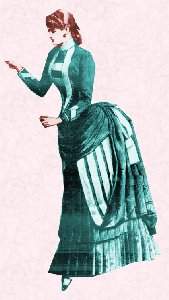
Right - The second hard bustle style 1883.
Right -La Grande Jatte by Georges Seurat 1884-6. Art Institute Chicago. This later bustle fashion was very moulded to the body and the heavy corsetry gave an armour like rigidity to the silhouette. The pointed bodice began to look quite tailored.
Right - Dress of 1889 showing signs of elevation at the sleeve head.
Bright Aniline Dyed Colours
1890s
Gradually the skirt widened and flared as the fullness of the bustle began to fall into pleats down the garment back eventually disappearing to nothing.
Left - Evening gown with train 1890.
Leg of Mutton Sleeves
 Two women in Victorian Gowns...

Velvet was a big trend, Silk was a trend too.
 Laces and frills added up the look...
 Victorian Women meeting up for an event...
 Different Victorian Shoes for women...
 Some additional research....
 some additional research...
The Final Garment sourced from The Costume Studio....
A lot of costumes shops searched like
Academy costumes
50 Rushworth Street, London, SE1 0RB, United Kingdom - 020 7620 0771
Costume Studio
159-161 Ball's Pond Road, London, N1 4BG, United Kingdom - 020 7275 9614
National Theatre Costume hire store
Chichester House, Kennington Park Business Estate, 1-3 Brixton Road, London, SW9 6DE, United Kingdom - 020 7735 4774
Flint hire and supply limited
39 Queen's Row, London, SE17 2PX, United Kingdom - 020 7703 9786

the final garment used is 1890 costume made of velvet, silk and lace....
The hair style and the look
 some curls and nude makeup with red lips....
 we used a little bun at the back of the head...


The male Costume and the Look
Late nineteenth century shirts
The shirt changed very little. The frilling for evening finally disappeared completely by the 1860s, the fronts being plain, stiffly starched and fastened with decorative studs. Collars, separate from the shirt, and cuffs were highly starched; cuffs showed an inch or so beyond the coat sleeve and for formal occasions were double, fastened with cufflinks. Collars were lower between the late 1850s and 1880, single and straight or winged on formal occasions, double — i.e. turned over — for informal. By the 1890s collars about 21-3 inches high were again in fashion, and many elderly men continued to wear the high collars with points projecting on to the cheeks which had been fashionable in their youth.
During the 1850s and early 1860s coloured shirts might be worn by working-class men, but gentlemen usually wore white. French printed cambrics in various coloured patterns were introduced for informal wear during the 1860s, and by the 1890s neat stripes in blue or pink were accepted as 'perfectly good form' even with frock coats, provided that the collar was white. Artistic, intellectual and unconventional gentlemen might wear shirts of solid colour; William Morris had one dyed indigo blue for him in his own workshops. The dickey (or dicky), a shirt-front with an attached collar of starched linen worn over a flannel shirt, was available throughout the period, though never worn by a gentleman; it was often a source of humour or ridicule.
The stock continued to be worn for sporting occasions, particularly for hunting. The cravat or necktie, now cut narrower in the centre where it went around the neck, then widening out, was tied in various ways. In the sailor's reef knot, from around 1870, the central knot had vertical borders at the sides with the ends flowing loosely; though very popular during the 1890s, it was rivalled by the four-in-hand (also known as a Derby) in which the knot presented a free edge above and below; this was worn informally under the turn-down shirt collar and was also adopted by women to wear with masculine-styled blouses. Also worn by both men and women in the 1890s was the Oxford tie, a narrow straight necktie of uniform width. The octagon, from the 1860s, and the Ascot, from 1876, were scarf-like: the former was a made-up tie with the front arranged with four tabs above a tie pin, fastening at the back with a hook and eyelet hole; the latter, though similar in appearance, was usually self-tied, and might be puffed out at the centre front and called a puffed Ascot. A broad necktie tied in a bow was worn during the 1850s and a small neat bow was particularly favoured during the 1890s, either tied by hand or ready-made; and the small white cambric bow tie was to become more or less obligatory for formal evening wear, although black might be seen until the end of the century.
follow is full set of research on the men's clothing and accessories...

 The Beaver hat...


The final Garment sourced from The Costume Studio....
 The look and hair...
We researched on different people of that time and found that rich snobs didnt kept mustaches much. But normal rich people kept various mustaches as per their significance in the society. here are some pictures of the different men of that time....


For other Pictures of different facial hair and their significance we can visit on this special blog...
http://mustachesofthenineteenthcentury.blogspot.com/
For the hair we let him keep short hair to give a look of fake rather than long slick hair like the usual Victorian men.

No comments:
Post a Comment