The Blue print suggest the pattern, wires and electronic used in processing of the garment.


The Piping is stitched in the garment to reduce the bulk and make the garment more movable and wearable.
 Me and Ikbal Hussain (production Manager) going to the shoot in Camden with apparatus.
 The shot getting ready..
 Jun (assistant stylist) helping the actor for final costumes and makeup
 Scene1, take 2...shooting in progress...
 A rock used to make a fake splash in water for the jumping scene...
 The actor's walkswagon used for travelling...
 Victoria shots in Studio B...
 Getting ready for the shot..
 The camera man (Tom Akerman) setting the angle according to the director...
 Modern day scene...with artificial sunlight
 Jun, the stylist after wrapping up the costumes,...
 Alan Gardner (director), working on the Final Draft
 The apparatus borrowed from ravensbourne college
 The last team meeting before the day of shoot
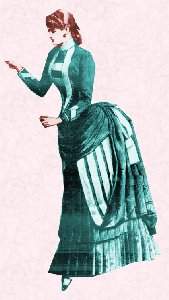
By 1878, women of the late Victorian era have a very different look about them compared to earlier Victorian women.
The soft polonaise style bustle styles were replaced by Princess sheath garments without a waist seam with bodice and skirt cut in one. The Princess line sheath had a bodice line similar to the very tight fitting cuirasse bodices which had been getting longer and longer.
Right - Slim fitting trained dress with cuirasse bodice 1876. By 1878 the cuirasse bodice reached the thighs.
By 1878 the cuirasse bodices had reached the thighs. The cuirasse bodice was corset like and dipped even deeper both front and back extending well down the hips creating the look of a body encased in armour.
By 1880 the two ideas merged and the whole of the dress was in Princess line style with shoulder to hem panels. The silhouette was slim and elongated even more by the train. No bustle was needed for the cuirasse bodice or Princess sheath dress, but a small pad would have helped any trained fabric to fall well.
Left - The cuirasse bodice of 1880 reached the hem actually becoming the princess panel dress. It made an exceptionally form fitting draped sheath dress which was elongated even further by the train.
The slim line style needed good dressmaking skills to get a flattering fit. When done well it was attractive, but all too often swathes of fabric were wrapped and arranged across the garment in an effort to disguise poor dressmaking skills. It was not a very practical garment and only really suited to the very slim and those who did not have to work. As a fashion it barely lasted 3 years.
Right - The second hard bustle style 1883.
Right -La Grande Jatte by Georges Seurat 1884-6. Art Institute Chicago. This later bustle fashion was very moulded to the body and the heavy corsetry gave an armour like rigidity to the silhouette. The pointed bodice began to look quite tailored.
Right - Dress of 1889 showing signs of elevation at the sleeve head.
Gradually the skirt widened and flared as the fullness of the bustle began to fall into pleats down the garment back eventually disappearing to nothing.
Left - Evening gown with train 1890.
 Two women in Victorian Gowns...

 Laces and frills added up the look...
 Victorian Women meeting up for an event...
 Different Victorian Shoes for women...
 Some additional research....
 some additional research...

 some curls and nude makeup with red lips....
 we used a little bun at the back of the head...


Late nineteenth century shirts
The shirt changed very little. The frilling for evening finally disappeared completely by the 1860s, the fronts being plain, stiffly starched and fastened with decorative studs. Collars, separate from the shirt, and cuffs were highly starched; cuffs showed an inch or so beyond the coat sleeve and for formal occasions were double, fastened with cufflinks. Collars were lower between the late 1850s and 1880, single and straight or winged on formal occasions, double — i.e. turned over — for informal. By the 1890s collars about 21-3 inches high were again in fashion, and many elderly men continued to wear the high collars with points projecting on to the cheeks which had been fashionable in their youth.
During the 1850s and early 1860s coloured shirts might be worn by working-class men, but gentlemen usually wore white. French printed cambrics in various coloured patterns were introduced for informal wear during the 1860s, and by the 1890s neat stripes in blue or pink were accepted as 'perfectly good form' even with frock coats, provided that the collar was white. Artistic, intellectual and unconventional gentlemen might wear shirts of solid colour; William Morris had one dyed indigo blue for him in his own workshops. The dickey (or dicky), a shirt-front with an attached collar of starched linen worn over a flannel shirt, was available throughout the period, though never worn by a gentleman; it was often a source of humour or ridicule.
The stock continued to be worn for sporting occasions, particularly for hunting. The cravat or necktie, now cut narrower in the centre where it went around the neck, then widening out, was tied in various ways. In the sailor's reef knot, from around 1870, the central knot had vertical borders at the sides with the ends flowing loosely; though very popular during the 1890s, it was rivalled by the four-in-hand (also known as a Derby) in which the knot presented a free edge above and below; this was worn informally under the turn-down shirt collar and was also adopted by women to wear with masculine-styled blouses. Also worn by both men and women in the 1890s was the Oxford tie, a narrow straight necktie of uniform width. The octagon, from the 1860s, and the Ascot, from 1876, were scarf-like: the former was a made-up tie with the front arranged with four tabs above a tie pin, fastening at the back with a hook and eyelet hole; the latter, though similar in appearance, was usually self-tied, and might be puffed out at the centre front and called a puffed Ascot. A broad necktie tied in a bow was worn during the 1850s and a small neat bow was particularly favoured during the 1890s, either tied by hand or ready-made; and the small white cambric bow tie was to become more or less obligatory for formal evening wear, although black might be seen until the end of the century.

 The Beaver hat...


 The look and hair...


Worthington, Charlotte, Producing: filmmaking / by Charlotte Worthington (2009) is an interesting book about the basic knowledge about producing and initiating a proper or a short film.
The main person I needed was an intelligent director who would guide me through the process and help me write the script out of scribbles of my thoughts and research. I met ALAN GARDNER (professional short film director), and we started the script. During this process i also read a book on script writing which told me some interesting things about writing the script.
Trottier, David, Screenwriter’s Bible (2005), screenwriting primer that provides a concise presentation of screenwriting basics.

Before starting the script I wanted to find evidence to match my thoughts, so the viewer visualizes easily and grasps the whole idea in one show.
While I was researching for interesting things and topics, I went through some key words like Metamorphosis, which means a gradual change of life or just a form. I explored it more and loved the concept as everything we do, everything we see, and everything we think of is connected to the process of gradual change and every time a new product or a visual is formed. We even cannot catch the time, which is gone, and history proves that the new time has brought change with it. I show this I wanted to use the slow motion effect in my film, which is process of filmmaking helps to clearly visualize the change.
Metamorphosis example...
Slow motion example
Through the concept I also wanted to show the change of worlds in time, so I wanted to explore some old century and compare it slowly to the present one.
As of limited recourses, I had to shoot in London itself. So I started researching on the famous eras of near past, London. The most interesting era, which came out, was the Victorian era. It came across the reign of Queen Victoria from June 1837 until her death on the 22nd of January 1901.

It was a vast series of decades. So, I thought of selecting the most influential time in nineteenth century fashion, 1875- 1890. A lot was changing at this time; technology was increasing, so it influenced fashion and lifestyles at this time too.
Late nineteenth century look
At this time particularly, the status of women was changing in the society as of the influence of Queen herself. The women were getting stronger, both emotionally and financially. The era spanned 64 years and changes in attitudes were gradually shifting as the century closed. Married Woman's Property Act 1887 It was a hypocritical period when relationships were quite artificial. Until late in the century in 1887 a married woman could own no property. Then in 1887 the Married Woman's Property Act gave women rights to own her own property. Previously her property, frequently inherited from her family, belonged to her husband on marriage. She became the chattel of the man. During this era if a wife separated from her husband she had no rights of access to see her children. A divorced woman had no chance of acceptance in society again.
Amelia- the female character (the name taken from all the Victorian era names.. http://freepages.genealogy.rootsweb.ancestry.com/~poindexterfamily/OldNames.html )
This gave me an Idea to build the female character of the film, Adriana, a rich and independent widow woman around 30 years of age (year 1890). She is a snob, flirtatious and an aggressive woman. She knows that she has money and how she can use it.
 Actress- Hadas Charline Eshkar, defined the look of the story.
Male Character- Benjamin (Nic Ofield)
His character is potrayed at fake rich guy around 30 yrs of age, who tries to kill the actress in order to get her money. His look as well as Actresses look would be dicussed later.
Writing the script...
Now I had the main character and the late nineteenth century, but somehow I had to connect it with the modern world and even take out a lesson out of it. So I made a dramatic story, mixing the facts and the visualization. Here is the script, with example video clips for different situations, which was an outcome of many progressive sessions.
INT. MODERN BEDROOM - NIGHT
Modern man’s REM, as seen by woman as she arouses him – 30 secs
Her hand fumbling about under the sheets
A smile spreads across his face
His eyes open, he grabs and kisses her hungrily and rolls on top of her
For mixing to next scene put some motion graphic likePshycadelic graphics example
mixes into the next scene which is victorian room, love making in slow motion
For love making scene, example of color isolation
INT. VICTORIAN BEDROOM - NIGHT
Man and woman making love – 30 secs
Intercut lovemaking and fighting for real (ie he’s trying to knife her). Let them run with it for 5-10 mins each scene and shoot it with two cameras
we see fire in actor's eye (Nic Ofield)
EXT. VICTORIAN ALLEYS – NIGHT
Man running thru alleys, running away from the scene of the crime – 30 secs
He’s just killed her and is running away as fast as possible
Manic, beside himself with adrenaline and “oh fuck what have I done?”
Blood on his face
Blind panic, lost, can’t find his way out, spinning around
Collapses in tears of despair.
Goes under the chandelier in Camden once
INT. VICTORIAN BEDROOM - NIGHT
I need graphics for my inspiration so let this scene start at a graphic made of crystal, starting from the chandelier shot in Camden when the man is running in the last scene
Man steals woman’s crystals – 30 secs
Stuff jewels into his pockets and leaving the room
She’s out of focus, looks like sleeping, in bed
EXT. VICTORIAN ALLEYS – NIGHT
Man running thru alleys, paranoid – 30 secs
He walks thru alleys, feeling jumpy
He starts to think he’s being followed
Shot hand held, from the pursuer’s POV, edgy framing, watching him
We see the occasional figure in the shadows, stepping back as man looks round
Shots from overhead – he’s being watched, but by whom?
INT. VICTORIAN BEDROOM – NIGHT
Blood dripping from woman’s hand onto sketch (of her?) the area burns with blood– 30 secs refer
Eyes staring unblinkingly, to the ceiling
Bloodstained sheet, revealing the scene of the crime
EXT. VICTORIAN ALLEYS - NIGHT
Man running thru alleys, stuck – 30 secs
Not getting anywhere. Looks down and he’s running on banana skins
Coming up against dead-ends
The pursuer is closing in
INT. VICTORIAN BEDROOM – NIGHT
Man stabs woman to death – 30 secs
EXT. VICTORIAN ALLEYS – NIGHT
Reaching a dead end, backing away from pursuer (modern man) Gothic Man jumps into canal
He climbs over barrier on bridge
Fearful look in his eyes
Hands let go of handrail
Feet slip off of bridge
Man leaping over camera slow-mo
Slow-mo of him falling, falling, falling – trampoline, shot slo-mo
POV falling towards water
Drop a huge block into water for splash
SFX shot of red ink in bowl of water swirling around
INT. MODERN BEDROOM - DAY
Modern man wakes up from dream gasping for breath – 30 secs
Covered in sweat
She’s looking at him
She reaches out to comfort him and he flinches from her touch
She follows him out and there is knife and a property paper at the side of his pillow…